Architecture
The Knowledge System solves the problem of amnesiac AI through automatic knowledge graph construction. Instead of requiring manual note-taking, it extracts and structures knowledge as a natural byproduct of conversation.
Core Architecture
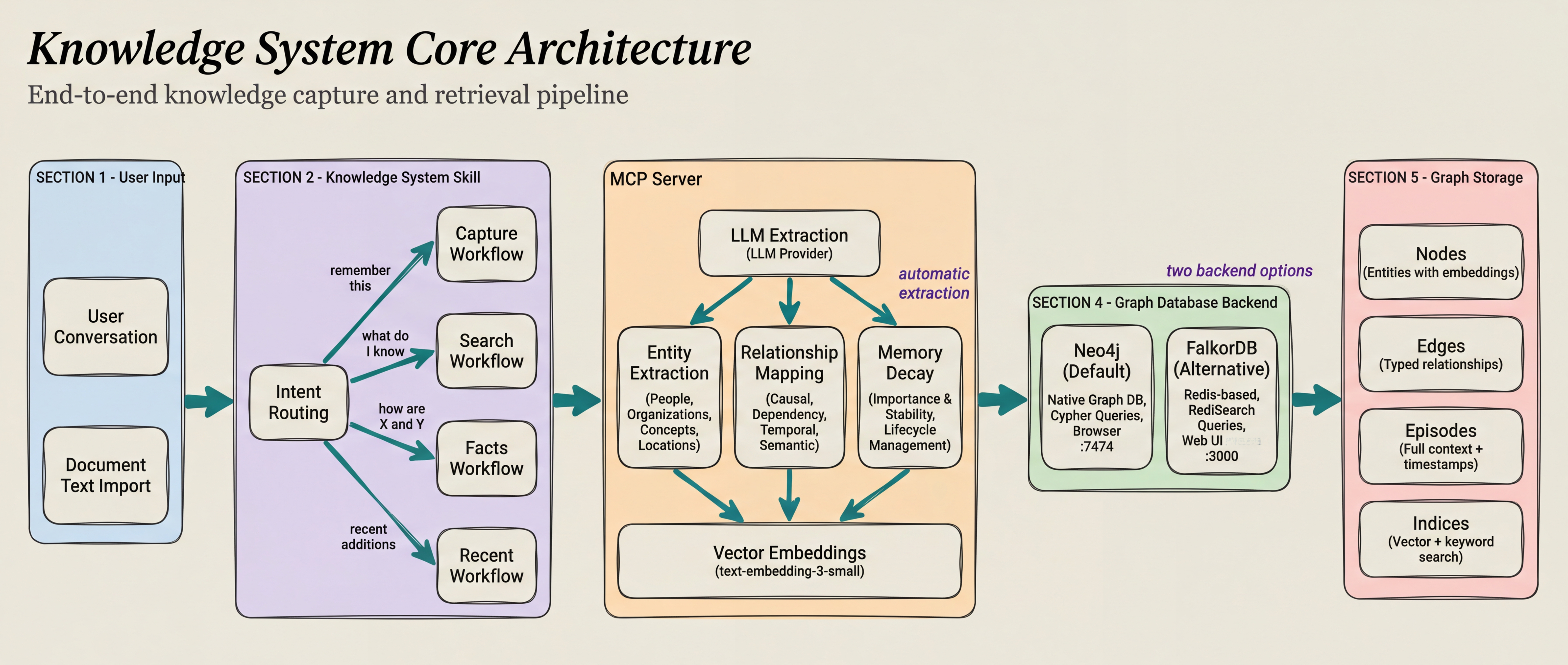
User conversation and document text flow through the Knowledge System Skill → Intent Routing → Graphiti MCP Server (with Memory Decay) → Graph Database Backend (Neo4j/FalkorDB) → Graph Storage (Nodes, Edges, Episodes, Indices)
How It Works
1. Natural Capture
Say "remember that Podman volumes use host:container syntax" and the system:
- Extracts entities: "Podman", "volume mounting"
- Identifies relationship: "uses", "syntax rule"
- Classifies importance and stability (Feature 009)
- Creates episode with full context
- Stores in graph with timestamp
2. Semantic Search
Ask "what do I know about container orchestration?" and the system:
- Searches vector embeddings for related concepts
- Applies weighted scoring: semantic (60%) + recency (25%) + importance (15%)
- Returns entities: "Podman", "Kubernetes", "Docker Compose"
- Shows relationships: "alternatives to", "similar tools"
- Displays episodes with full context
3. Relationship Discovery
Ask "how are FalkorDB and Graphiti connected?" and the system:
- Traverses graph edges between entities
- Returns: "FalkorDB is the graph database backend for Graphiti"
- Shows temporal context: "learned on 2025-01-03"
- Displays related entities and connections
Design Principles
- Zero Friction: Capture knowledge through natural conversation
- Automatic Extraction: LLM-powered entity and relationship detection
- Semantic Understanding: Vector embeddings enable concept-based search
- Temporal Tracking: Know when knowledge was added and how it evolves
- Graph-Based: Explicit relationships show how concepts connect
- Memory Prioritization: Automatic importance/stability classification with decay scoring (Feature 009)
- Complete: Every component included - MCP server, PAI skill, workflows
Multi-Layered Architecture
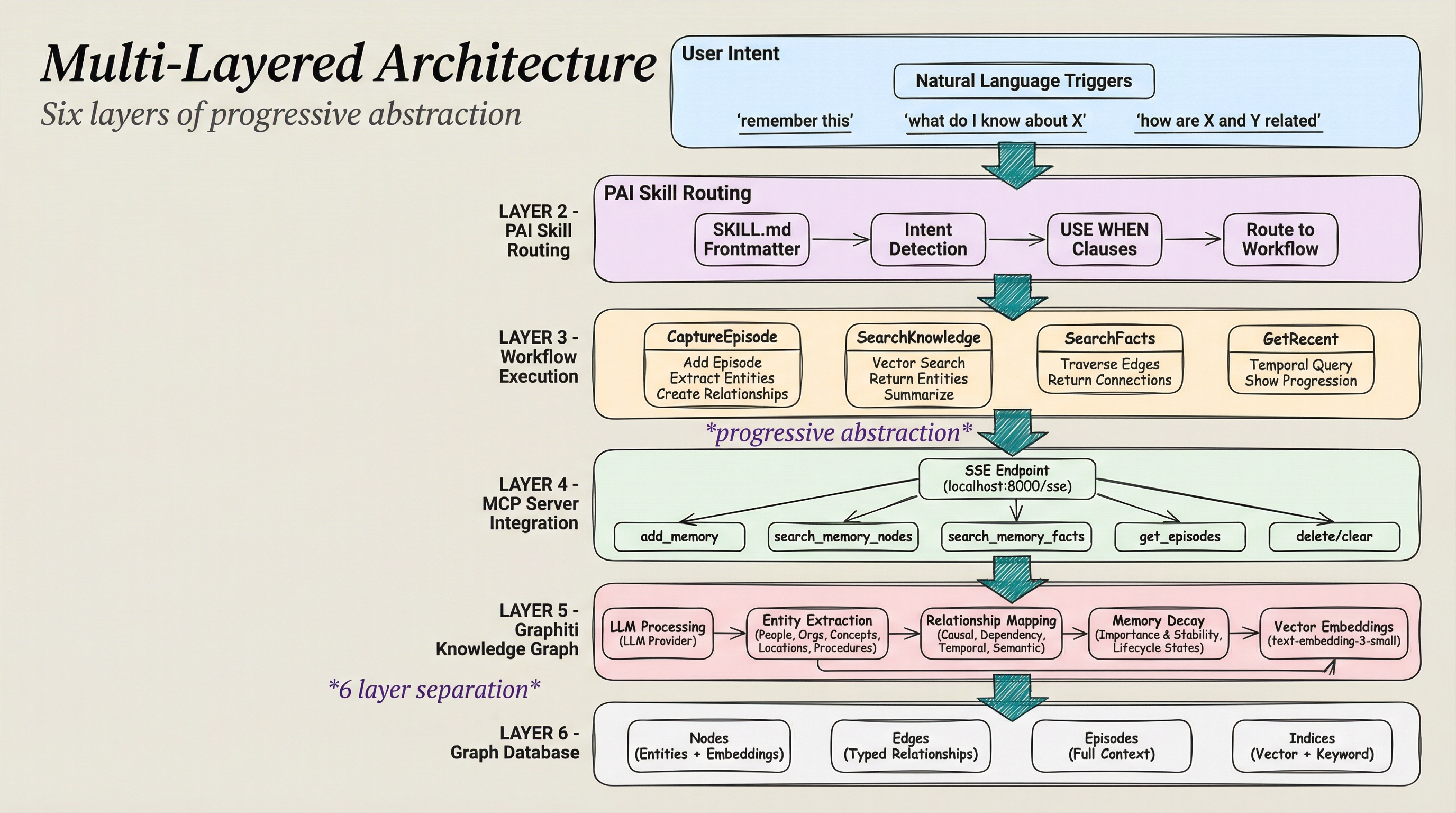
The system uses progressive abstraction across 6 layers:
Layer 1 - User Intent: Natural language triggers ("remember this", "what do I know", "how are X and Y")
Layer 2 - PAI Skill Routing: SKILL.md frontmatter → Intent Detection → Workflow routing
Layer 3 - Workflow Execution: CaptureEpisode, SearchKnowledge, SearchFacts, GetRecent
Layer 4 - MCP Server Integration: SSE Endpoint (localhost:8000/sse) → add_memory, search_memory_nodes, search_memory_facts, get_episodes
Layer 5 - Graphiti Knowledge Graph: LLM Processing → Entity Extraction → Relationship Mapping → Memory Decay → Vector Embeddings
Layer 6 - Graph Database: Nodes (Entities + Embeddings), Edges (Typed Relationships), Episodes (Full Context), Indices (Vector + Keyword)
Architectural Advantages
1. Separation of Concerns
Each layer has a single responsibility:
- Intent Layer: Natural language understanding
- Routing Layer: Direct user intent to workflow
- Workflow Layer: Operational procedures
- Server Layer: API abstraction
- Graph Layer: Knowledge operations
- Database Layer: Persistent storage
This is FUNDAMENTALLY DIFFERENT from "just storing notes" because:
- Progressive abstraction (not everything in one layer)
- Explicit intent routing (not fuzzy keyword matching)
- Separation of operations (capture, search, retrieve distinct)
- Deterministic execution (workflows map intent to MCP calls)
2. Bidirectional Knowledge Flow
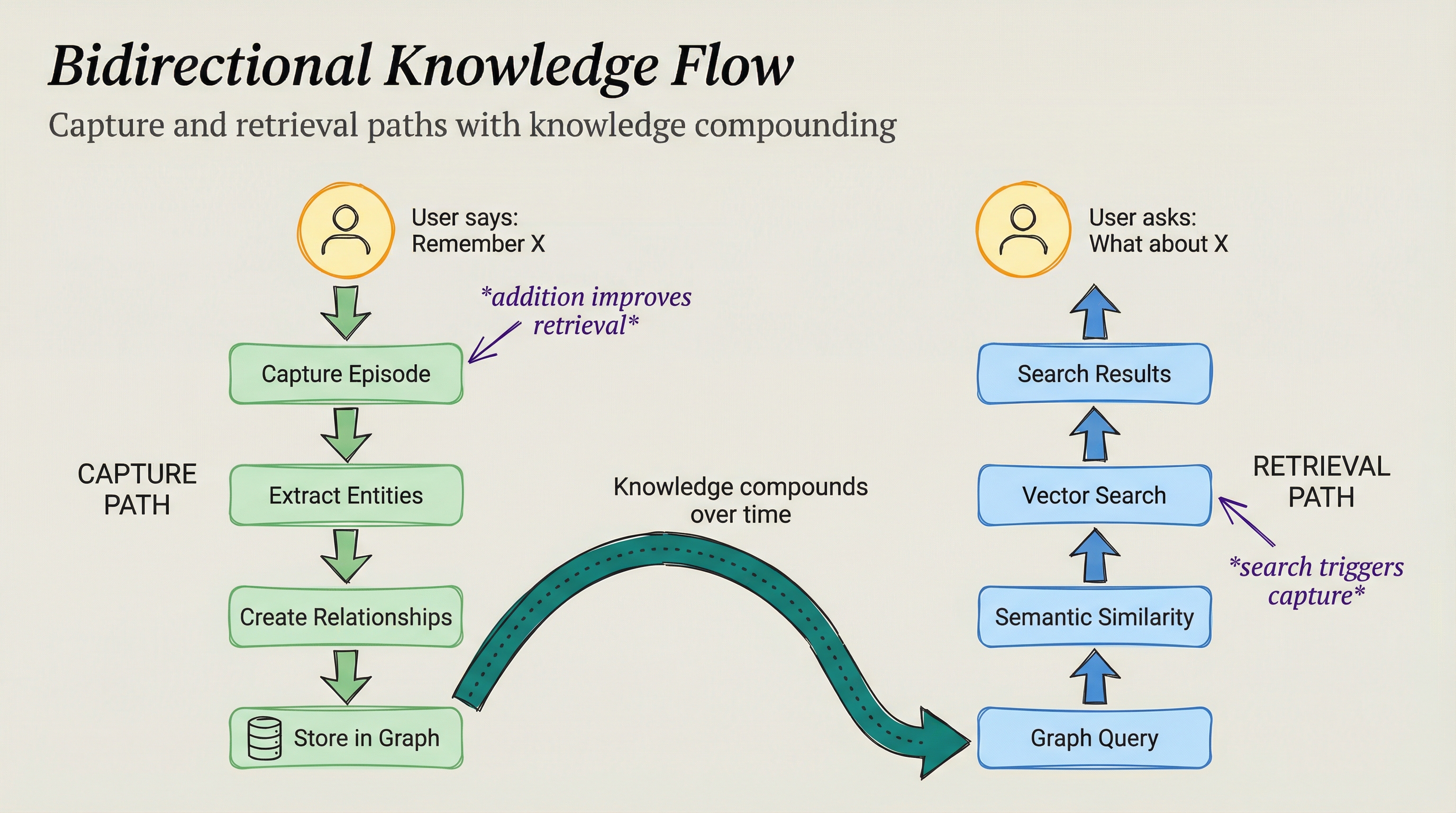
Capture path (green): User says "Remember X" → Capture Episode → Extract Entities → Create Relationships → Store in Graph
Retrieval path (blue): Graph Query → Semantic Similarity → Vector Search → Search Results → User asks "What about X"
Center: Knowledge compounds over time (dotted arrow)
Every knowledge addition improves future retrieval. Every search result can trigger new knowledge capture.
3. Multi-Dimensional Retrieval
Traditional search: Keyword matching in flat text Knowledge graph: Three retrieval dimensions
| Dimension | Mechanism | Example Query | Result Type |
|---|---|---|---|
| Semantic | Vector embeddings | "container orchestration" | Podman, Kubernetes, Docker |
| Relational | Graph traversal | "how are X and Y related" | "X uses Y as backend" |
| Temporal | Episode timestamps | "what did I learn about X" | Chronological episodes |
4. Automatic Entity Extraction
LLM-powered extraction identifies:
- Named Entities: People, organizations, locations
- Abstract Concepts: Technologies, methodologies, patterns
- Procedural Knowledge: Workflows, SOPs, how-to guides
- Preferences: Choices, configurations, opinions
- Requirements: Features, needs, specifications
This happens AUTOMATICALLY - no manual tagging required.
5. Temporal Context Tracking
Every episode includes:
- Timestamp: When knowledge was added
- Source: Conversation or document
- Entity State: How understanding evolved
- Relationship Creation: When connections were made
Example: "FalkorDB backend for Graphiti (learned 2025-01-03, updated 2025-01-05)"
6. Lucene Query Sanitization
The knowledge system includes automatic query sanitization to handle special characters in search terms, particularly important for CTI/OSINT data with hyphenated identifiers (e.g., apt-28, threat-intel).
Full Documentation
For detailed information about Lucene query sanitization, including the problem, solution, and sanitization functions, see src/server/lib/lucene.ts.
Component Stack
The architecture includes every component needed for end-to-end operation:
- ✅ MCP Server:
bun run server-cli startstarts Graphiti + Neo4j/FalkorDB - ✅ PAI Skill:
SKILL.mdwith intent routing - ✅ Workflows: 7 complete operational procedures
- ✅ Installation: Step-by-step in
tools/Install.md - ✅ Configuration: All settings in PAI config (
$PAI_DIR/.env) - ✅ Documentation: README, INSTALL, VERIFY
- ✅ Query Sanitization: Handles special characters automatically
NOT: "You need to set up your own vector database" - FalkorDB is included NOT: "Implement your own entity extraction" - Graphiti handles it NOT: "Configure your own embeddings" - OpenAI integration built-in NOT: "Handle special characters manually" - Lucene sanitization built-in
Knowledge Architecture Innovation
The key insight is that knowledge is relational, not transactional. Traditional note-taking treats each piece of information as an isolated transaction. The Madeinoz Knowledge System treats knowledge as a graph of interconnected entities with temporal context.
This isn't just "better search" - it's a fundamentally different paradigm:
- Transaction: "Note about Podman volumes" (isolated, static)
- Relational: "Podman → uses → volume mounting → syntax → host:container" (connected, queryable, temporal)
The graph structure allows queries impossible with flat notes:
- "Show me all technologies related to container orchestration I learned about in the past month"
- "What debugging solutions led to architectural decisions?"
- "How do my preferences for dev tools relate to past troubleshooting sessions?"
- "Find all CTI indicators from group 'apt-28'"
This architecture makes your AI infrastructure genuinely intelligent, not just a better filing cabinet.
Problems This Architecture Prevents
| Problem | Traditional Approach | Knowledge Graph Approach |
|---|---|---|
| Keyword limits | Must know exact terms | Semantic similarity finds related concepts |
| Siloed information | Notes in separate files | Graph connects everything |
| Lost context | No temporal tracking | Every episode has timestamp |
| No relationships | Flat documents | Explicit edges between entities |
| Manual organization | Tag and categorize yourself | Automatic entity extraction |
| Scattered knowledge | Multiple tools | Single unified graph |
| Hyphenated identifiers | Query syntax errors | Automatic sanitization |